Project 3: Ants Vs. SomeBees
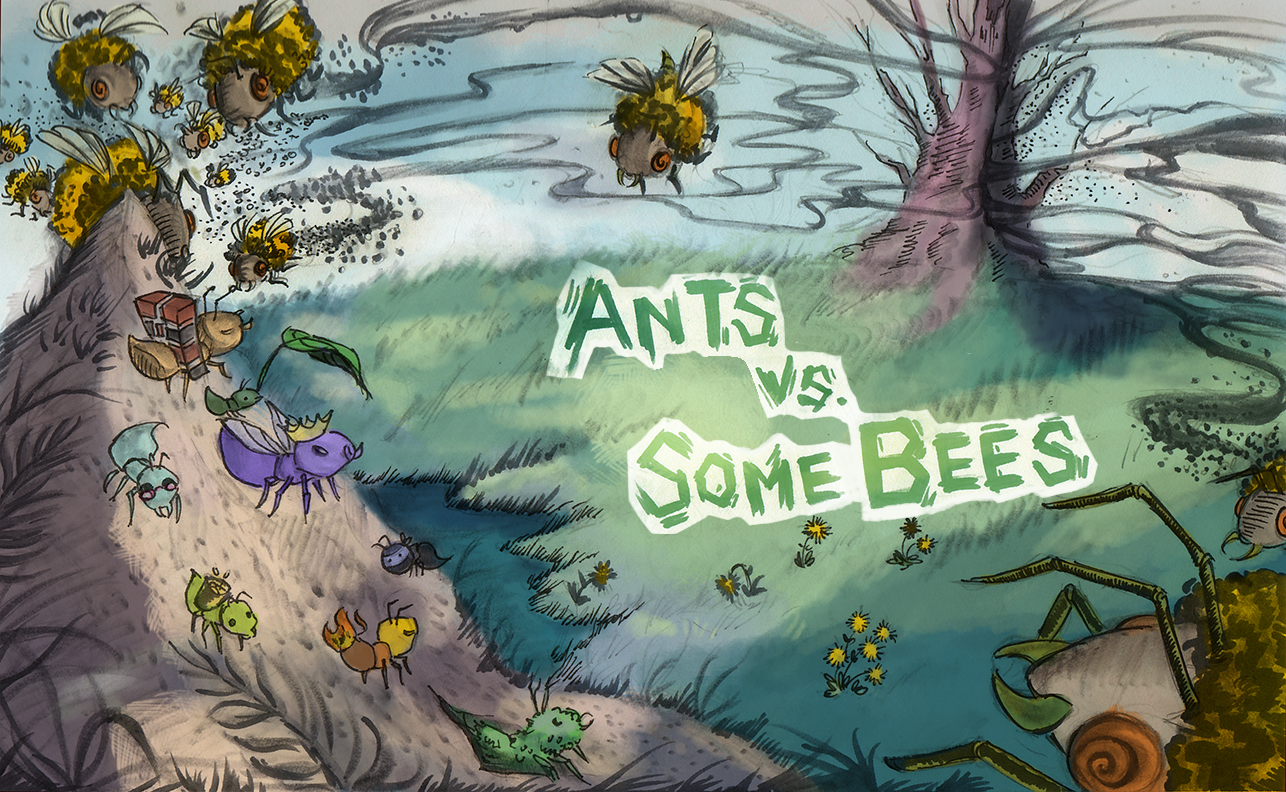
The bees are coming!
Create a better soldier
With inherit-ants.
Introduction
Important submission note: For full credit,
- Submit with Phases 1 & 2 complete by Tuesday, March 9 (worth 1 pt).
- Submit with Phase 3 complete by Friday, March 12 (worth 1 pt).
- Submit with Phase 4 complete by Tuesday, March 16.
You may work with one other partner for the entire project. You will get an extra credit point for submitting the entire project by Monday, March 15.
In this project, you will create a tower defense game called Ants Vs. SomeBees. As the ant queen, you populate your colony with the bravest ants you can muster. Your ants must protect their queen from the evil bees that invade your territory. Irritate the bees enough by throwing leaves at them, and they will be vanquished. Fail to pester the airborne intruders adequately, and your queen will succumb to the bees' wrath. This game is inspired by PopCap Games' Plants Vs. Zombies.
This project uses an object-oriented programming paradigm, focusing on material from Chapter 2.5 of Composing Programs. The project also involves understanding, extending, and testing a large program.
Download starter files
The ants.zip archive contains several files, but all of your
changes will be made to ants.py.
ants.py: The game logic of Ants Vs. SomeBeesants_gui.py: The original GUI for Ants Vs. SomeBeesgui.py:A new GUI for Ants Vs. SomeBees.graphics.py: Utilities for displaying simple two-dimensional animationsutils.py: Some functions to facilitate the game interfaceucb.py: Utility functions for CS 61Astate.py: Abstraction for gamestate for gui.pyassets: A directory of images and files used bygui.pyimg: A directory of images used byants_gui.pyok: The autograderproj3.ok: Theokconfiguration filetests: A directory of tests used byok
Logistics
This is a project. You may work with one other partner. You should not share your code with students who are not your partner or copy from anyone else's solutions. In the end, you will submit one project for both partners. We strongly encourage you to use pair programming to work on all parts of the project together rather than splitting up the work. Whoever is not coding should contribute by looking at the code and providing comments on a direction to go and catching bugs.
The project is worth 28 points. 24 points are assigned for correctness, 1 point for submitting Phases 1-2 by the first checkpoint date, 1 point for submitting Phases 1-3 by the second checkpoint date, and 2 points for the overall composition.
You will turn in the following files:
ants.py
You do not need to modify or turn in any other files to complete the project. To submit the project, run the following command:
python3 ok --submitYou will be able to view your submissions on the Ok dashboard.
For the functions that we ask you to complete, there may be some initial code that we provide. If you would rather not use that code, feel free to delete it and start from scratch. You may also add new function definitions as you see fit.
However, please do not modify any other functions. Doing so may result in your code failing our autograder tests. Also, please do not change any function signatures (names, argument order, or number of arguments).
Throughout this project, you should be testing the correctness of your code. It is good practice to test often, so that it is easy to isolate any problems. However, you should not be testing too often, to allow yourself time to think through problems.
We have provided an autograder called ok to help you
with testing your code and tracking your progress. The first time you run the
autograder, you will be asked to log in with your Ok account using your web
browser. Please do so. Each time you run ok, it will back up
your work and progress on our servers.
The primary purpose of ok is to test your implementations.
We recommend that you submit after you finish each problem. Only your last submission will be graded. It is also useful for us to have more backups of your code in case you run into a submission issue. If you forget to submit, your last backup will be automatically converted to a submission.
If you do not want us to record a backup of your work or information about your progress, you can run
python3 ok --localWith this option, no information will be sent to our course servers. If you want to test your code interactively, you can run
python3 ok -q [question number] -iwith the appropriate question number (e.g.
01) inserted.
This will run the tests for that question until the first one you failed,
then give you a chance to test the functions you wrote interactively.
You can also use the debugging print feature in OK by writing
print("DEBUG:", x)
which will produce an output in your terminal without causing OK tests to fail
with extra output.
The Game
A game of Ants Vs. SomeBees consists of a series of turns. In each turn, new
bees may enter the ant colony. Then, new ants are placed to defend their colony.
Finally, all insects (ants, then bees) take individual actions. Bees either try
to move toward the end of the tunnel or sting ants in their way. Ants perform a
different action depending on their type, such as collecting more food or
throwing leaves at the bees. The game ends either when a bee reaches the end of
the tunnel (you lose), the bees destroy the QueenAnt if it exists (you lose),
or the entire bee fleet has been vanquished (you win).
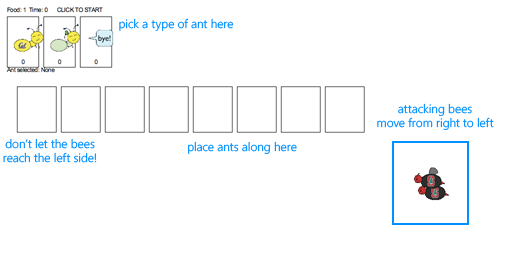
Core concepts
The Colony. This is where the game takes place. The colony consists of several places that are chained together to form a tunnel where bees can travel through. The colony also has some quantity of food which can be expended in order to place an ant in a tunnel.
Places. A place links to another place to form a tunnel. The player can place a single ant into each place. However, there can be many bees in a single place.
The Hive. This is the place where bees originate. Bees exit the beehive to enter the ant colony.
Ants. Players place an ant into the colony by selecting from the
available ant types at the top of the screen.
Each type of ant takes a different action and requires a different
amount of colony food to place. The two most basic ant types are the HarvesterAnt,
which adds one food to the colony during each turn, and the ThrowerAnt, which
throws a leaf at a bee each turn. You will be implementing many more!
Bees. In this game, bees are the antagonistic forces that the player must defend the ant colony from. Each turn, a bee either advances to the next place in the tunnel if no ant is in its way, or it stings the ant in its way. Bees win when at least one bee reaches the end of a tunnel.
Core classes
The concepts described above each have a corresponding class that encapsulates the logic for that concept. Here is a summary of the main classes involved in this game:
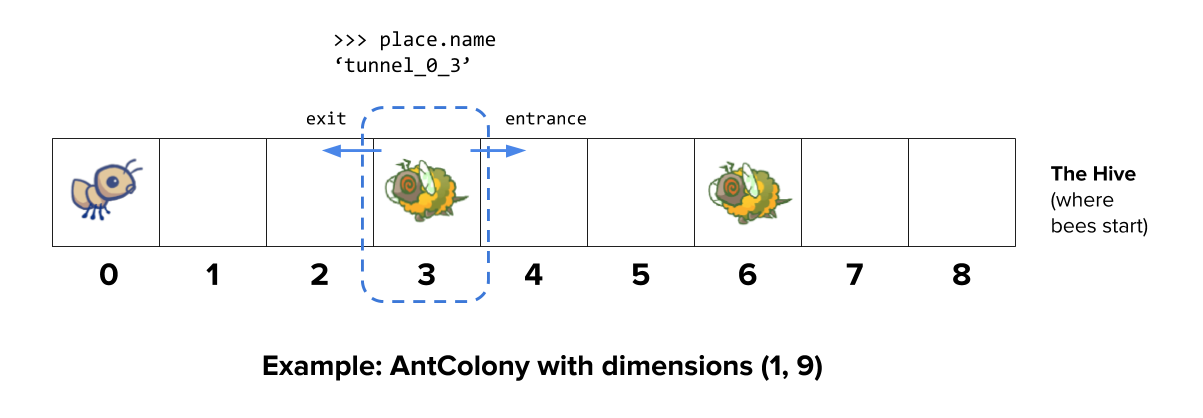
GameState: Represents the colony and some state information about the game, including how much food is available, how much time has elapsed, where theAntHomeBaseis, and all thePlaces in the game.Place: Represents a single place that holds insects. At most oneAntcan be in a single place, but there can be manyBees in a single place.Placeobjects have anexitto the left and anentranceto the right, which are also places. Bees travel through a tunnel by moving to aPlace'sexit.Hive: Represents the place whereBees start out (on the right of the tunnel).AntHomeBase: Represents the placeAnts are defending (on the left of the tunnel). If Bees get here, they win :(Insect: A superclass forAntandBee. All insects havehealthattribute, representing their remaining health, and aplaceattribute, representing thePlacewhere they are currently located. Each turn, every activeInsectin the game performs itsaction.Ant: Represents ants. EachAntsubclass has special attributes or a specialactionthat distinguish it from otherAnttypes. For example, aHarvesterAntgets food for the colony and aThrowerAntattacksBees. Each ant type also has afood_costattribute that indicates how much it costs to deploy one unit of that type of ant.Bee: Represents bees. Each turn, a bee either moves to theexitof its currentPlaceif thePlaceis notblockedby an ant, or stings the ant occupying its samePlace.
Game Layout
Below is a visualization of a GameState. As you work through the unlocking tests and problems, we recommend drawing out similar diagrams to help your understanding.
Playing the game
The game can be run in two modes: as a text-based game or using a graphical user interface (GUI). The game logic is the same in either case, but the GUI enforces a turn time limit that makes playing the game more exciting. The text-based interface is provided for debugging and development.
The files are separated according to these two modes. ants.py knows
nothing of graphics or turn time limits.
To start a text-based game, run
python3 ants_text.pyTo start a graphical game, run
python3 gui.pyWhen you start the graphical version, a new browser window should appear. In the
starter implementation, you have unlimited food and your ants can only throw leaves
at bees in their current Place. Before you complete Problem 2, the GUI may crash since it doesn't have a full conception of what a Place is yet! Try playing the game anyway! You'll need to
place a lot of ThrowerAnts (the second type) in order to keep the bees from
reaching your queen.
The game has several options that you will use throughout the project,
which you can view with python3 ants_text.py --help.
usage: ants_text.py [-h] [-d DIFFICULTY] [-w] [--food FOOD]

Play Ants vs. SomeBees

optional arguments:
  -h, --help     show this help message and exit
  -d DIFFICULTY  sets difficulty of game (test/easy/normal/hard/extra-hard)
  -w, --water    loads a full layout with water
  --food FOOD    number of food to start with when testing
Phase 1: Basic gameplay
Important submission note: For full credit,
- Submit with Phases 1-2 complete by Tuesday, March 9 (worth 1 pt).
In the first phase you will complete the implementation that will allow for
basic gameplay with the two basic Ants: the HarvesterAnt and the
ThrowerAnt.
Phase 1 Hint Videos
Problem 0 (0 pt)
Answer the following questions with your partner after you have read the
entire ants.py file.
To submit your answers, run
python3 ok -q 00 -uIf you cannot answer these questions, read the file again, consult the core concepts/classes sections above, or ask a question in the Question 0 thread on Piazza.
- What is the significance of an Insect's
healthattribute? Does this value change? If so, how? - Which of the following is a class attribute of the
Insectclass? - Is the
healthattribute of theAntclass an instance attribute or class attribute? Why? - Is the
damageattribute of anAntsubclass (such asThrowerAnt) an instance attribute or class attribute? Why? - Which class do both
AntandBeeinherit from? - What do instances of
Antand instances ofBeehave in common? - How many insects can be in a single
Placeat any given time (before Problem 8)? - What does a
Beedo during one of its turns? - When is the game lost?
Remember to run
python3 ok -q 00 -uProblem 1 (1 pt)
Before writing any code, read the instructions and test your understanding of the problem:
python3 ok -q 01 -uPart A: Currently, there is no cost
for placing any type of Ant, and so there is no challenge to the
game. The base class Ant has a food_cost of
zero. Override this class attribute for HarvesterAnt and ThrowerAnt
according to the "Food cost" column in the table below.
| Class | Food Cost | Initial Health |
 HarvesterAnt |
2 | 1 |
 ThrowerAnt |
3 | 1 |
Part B: Now that placing an Ant costs food, we need to be able to gather more food!
To fix this issue, implement the HarvesterAnt class. A HarvesterAnt is a
type of Ant that adds one food to the gamestate.food total as its action.
After writing code, test your implementation:
python3 ok -q 01Try playing the game by running python3 gui.py. Once you have placed a
HarvesterAnt, you should accumulate food each turn. You can also place
ThrowerAnts, but you'll see that they can only attack bees that are in their
Place, so it'll be a little difficult to win.
Problem 2 (2 pt)
Before writing any code, read the instructions and test your understanding of the problem:
python3 ok -q 02 -uIn this problem, you'll complete Place.__init__ by adding code that tracks entrances. Right
now, a Place keeps track only of its exit. We would like a Place to keep
track of its entrance as well. A Place needs to track only one entrance.
Tracking entrances will be useful when an Ant needs to see what Bees are in
front of it in the tunnel.
However, simply passing an entrance to a Place constructor will be
problematic; we would need to have both the exit and the entrance before
creating a Place! (It's a chicken or the
egg
problem.) To get around this problem, we will keep track of entrances in the
following way instead. Place.__init__ should use this logic:
- A newly created
Placealways starts with itsentranceasNone. - If the
Placehas anexit, then theexit'sentranceis set to thatPlace.
Hint: Remember that when the
__init__method is called, the first parameter,self, is bound to the newly created object
Hint: Try drawing out two
Places next to each other if things get confusing. In the GUI, a place'sentranceis to its right while theexitis to its left.
As a reminder, the game layout is as follows:
After writing code, test your implementation:
python3 ok -q 02Problem 3 (2 pt)
Before writing any code, read the instructions and test your understanding of the problem:
python3 ok -q 03 -uIn order for a ThrowerAnt to throw a leaf, it must know which bee to hit.
The provided implementation of the nearest_bee method in the ThrowerAnt
class only allows them to hit bees in the same Place. Your job is to fix it
so that a ThrowerAnt will throw_at the nearest bee in front of it that is not still in the Hive.
Change nearest_bee so that it returns a random Bee from the nearest place that
contains bees. Your implementation should follow this logic:
- Start from the current
Placeof theThrowerAnt. - For each place, return a random bee if there is any, and if not,
inspect the place in front of it (stored as the current place's
entrance). - If there is no bee to attack, return
None.
Hint: The
bee_selectorfunction provided inants.pyreturns a random bee from a list of bees orNoneif the list is empty.Hint: Having trouble visualizing the test cases? Try drawing them out on paper! The sample diagram provided in Game Layout shows the first test case for this problem.
After writing code, test your implementation:
python3 ok -q 03After implementing nearest_bee, a ThrowerAnt should be able to throw_at a
Bee in front of it that is not still in the Hive. Make sure that your ants
do the right thing! To start a game with ten food (for easy testing):
python3 gui.py --food 10Phase 2: Ants!
Now that you've implemented basic gameplay with two types of Ants, let's
add some flavor to the ways ants can attack bees. In this phase, you'll be
implementing several different Ants with different attack strategies.
After you implement each Ant subclass in this section, you'll need to set its
implemented class attribute to True so that that type of ant will show up in the
GUI. Feel free to try out the game with each new ant to test the functionality!
With your Phase 2 ants, try python3 gui.py -d easy to play against a
full swarm of bees in a multi-tunnel layout and try -d normal, -d hard, or
-d extra-hard if you want a real challenge! If the bees are too numerous to
vanquish, you might need to create some new ants.
Phase 2 Hint Videos
Problem 4 (3 pt)
Before writing any code, read the instructions and test your understanding of the problem:
python3 ok -q 04 -uA ThrowerAnt is a powerful threat to the bees, but it has a high food cost.
In this problem, you'll implement two subclasses of ThrowerAnt that are less
costly but have constraints on the distance they can throw:
- The
LongThrowercan onlythrow_ataBeethat is found after following at least 5entrancetransitions. It cannot hitBees that are in the samePlaceas it or the first 4Places in front of it. If there are twoBees, one too close to theLongThrowerand the other within its range, theLongThrowershould only throw at the fartherBee, which is within its range, instead of trying to hit the closerBee. - The
ShortThrowercan onlythrow_ataBeethat is found after following at most 3entrancetransitions. It cannot throw at any ants further than 3Places in front of it.
Neither of these specialized throwers can throw_at a Bee that is exactly 4
Places away.
| Class | Food Cost | Initial Health |
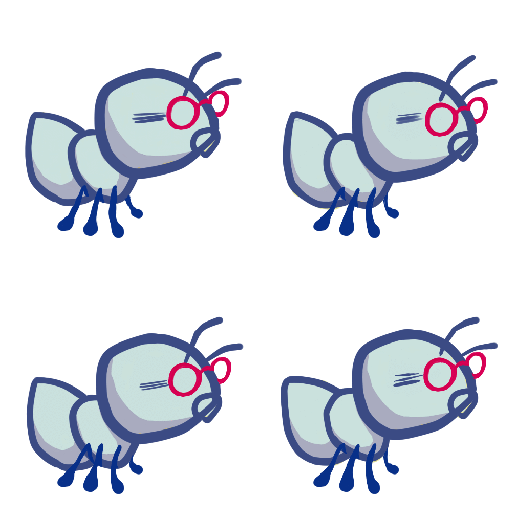 ShortThrower |
2 | 1 |
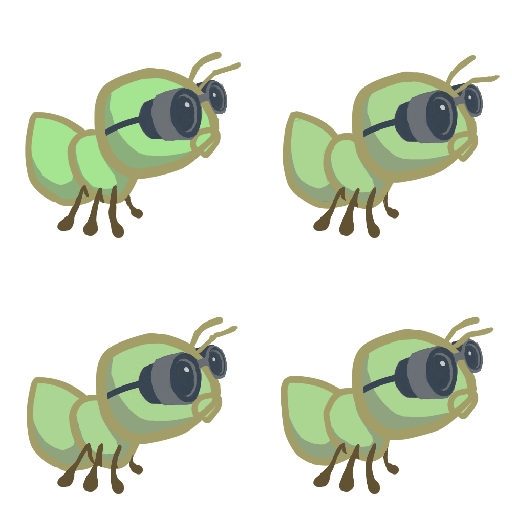 LongThrower |
2 | 1 |
To implement these new throwing ants, your ShortThrower and LongThrower classes
should inherit the nearest_bee method from the base ThrowerAnt class.
The logic of choosing which bee a thrower ant will attack is essentially
the same, except the ShortThrower and LongThrower ants have maximum and
minimum ranges, respectively.
Then, modify the nearest_bee method to reference min_range and max_range attributes,
and only return a bee that is in range.
Make sure to give these min_range and max_range sensible values in ThrowerAnt that do
not change its behavior. Then, implement the subclasses LongThrower and ShortThrower with appropriately
constrained ranges.
Hint:
float('inf')returns an infinite positive value represented as a float that can be compared with other numbers.Hint: You can chain inequalities in Python: e.g.
2 < x < 6will check ifxis between 2 and 6. Also,min_rangeandmax_rangeshould mark an inclusive range.Important! Please make sure your class attributes are called
max_rangeandmin_rangerather thanmaximum_rangeandminimum_rangeor something. The tests directly reference this attribute name.
Don't forget to set the implemented class attribute of LongThrower and
ShortThrower to True.
After writing code, test your implementation (rerun the tests for 03 to make sure they still work):
python3 ok -q 03
python3 ok -q 04👩🏽💻👨🏿💻 Pair programming? Remember to alternate between driver and navigator roles! The driver controls the keyboard; the navigator watches, asks questions, and suggests ideas.
Problem 5 (3 pt)
Before writing any code, read the instructions and test your understanding of the problem:
python3 ok -q 05 -uImplement the FireAnt, which does damage when it receives damage. Specifically,
if it is damaged by amount health units, it does a damage of
amount to all bees in its place (this is called reflected damage). If it dies, it does an additional amount of damage, as specified by its damage attribute.
To implement this, override FireAnt's reduce_health method.
Your overriden method should call the reduce_health method inherited from Ant,
which is itself inherited from Insect to reduce the current FireAnt instance's health. That base reduce_health method reduces the
insect's health by the given amount and remove the insect from its place if
health reaches zero or lower.
Your method needs to also include the reflective damage logic, however:
- Determine the reflective damage amount, by starting with the
amountinflicted on the ant, and then addingdamageif the ant's health has dropped to 0. - For each bee in the place, damage them with the total amount by calling the
reduce_healthmethod inherited fromInsect.
The FireAnt must do its damage before being removed from its place, so pay
careful attention to the order of your logic in the overriden method.
| Class | Food Cost | Initial Health |
 FireAnt |
5 | 3 |
Hint: Do not call
self.reduce_health, or you'll end up stuck in a recursive loop. (Can you see why?)Hint: Damaging a bee may cause it to be removed from its place. If you iterate over a list, but change the contents of that list at the same time, you may not visit all the elements. This can be prevented by making a copy of the list. You can either use a list slice, or use the built-in
listfunction.>>> lst = [1,2,3,4] >>> lst[:] [1, 2, 3, 4] >>> list(lst) [1, 2, 3, 4] >>> lst[:] is not lst and list(lst) is not lst True
Once you've finished implementing the FireAnt, give it a class attribute
implemented with the value True.
Even though you are overriding the
Insect.reduce_healthfunction, you can still use it in your implementation by calling it directly (rather than viaself). Note that this is not recursion (why?)
After writing code, test your implementation:
python3 ok -q 05You can also test your program by playing a game or two! A FireAnt should
destroy all co-located Bees when it is stung. To start a game with ten food
(for easy testing):
python3 gui.py --food 10Make sure to submit by the earlier deadline using the following command
python3 ok --submitYou can check to ensure that you have completed Phase 1-2's problems by running
python3 ok --scoreCongratulations! You have finished Phases 1 and 2 of this project!
Phase 3: More Ants!
Important submission note: For full credit,
- Submit with Phases 3 complete by Friday, March 12.
Phase 3 Hint Videos
Problem 6 (2 pt)
Before writing any code, read the instructions and test your understanding of the problem:
python3 ok -q 06 -uWe are going to add some protection to our glorious home base by implementing
the WallAnt, which is an ant that does nothing each turn. A WallAnt is
useful because it has a large health value.
| Class | Food Cost | Initial Health |
 WallAnt |
4 | 4 |
Unlike with previous ants, we have not provided you with a class header.
Implement the WallAnt class from scratch. Give it a class attribute name
with the value 'Wall' (so that the graphics work) and a class attribute
implemented with the value True (so that you can use it in a game).
After writing code, test your implementation:
python3 ok -q 06Problem 7 (3 pt)
Before writing any code, read the instructions and test your understanding of the problem:
python3 ok -q 07 -uImplement the HungryAnt, which will select a random Bee from its place
and eat it whole. After eating a Bee, it must spend 3 turns chewing before
eating again. If there is no bee available to eat, it will do nothing.
We have not provided you with a class header.
Implement the HungryAnt class from scratch. Give it a class attribute name
with the value 'Hungry' (so that the graphics work) and a class attribute
implemented with the value True (so that you can use it in a game).
| Class | Food Cost | Initial Health |
 HungryAnt |
4 | 1 |
Give HungryAnt a chew_duration class attribute that stores the number of
turns that it takes a HungryAnt to chew (set to 3). Also, give each
HungryAnt an instance attribute chewing that counts the number of turns
it has left to chew (initialized to 0, since it hasn't eaten anything at the
beginning).
Implement the action method of the HungryAnt to check if it is chewing; if
so, decrement its chewing counter. Otherwise, eat a random Bee in its
place by reducing the Bee's health to 0 and restart the chewing timer.
Hint: Other than the
actionmethod, make sure you implement the__init__method too so theHungryAntstarts off with the appropriate amount ofhealth!
After writing code, test your implementation:
python3 ok -q 07We now have some great offensive troops to help vanquish the bees, but let's make sure we're also keeping our defensive efforts up. In this phase you will implement ants that have special defensive capabilities such as increased health and the ability to protect other ants.
👨🏾💻👩🏻💻 Pair programming? This is a good time to switch roles! Switching roles makes sure that you both benefit from the learning experience of being in each role.
Problem 8 (3 pt)
Before writing any code, read the instructions and test your understanding of the problem:
python3 ok -q 08 -uRight now, our ants are quite frail. We'd like to provide a way to help them
last longer against the onslaught of the bees. Enter the BodyguardAnt.
| Class | Food Cost | Initial Health |
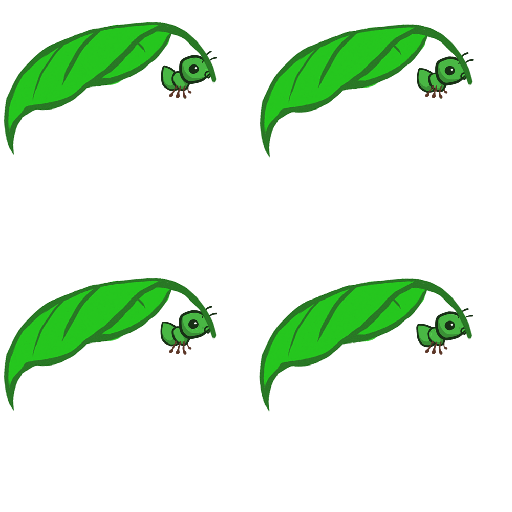 BodyguardAnt |
4 | 2 |
A BodyguardAnt differs from a normal ant because it is a ContainerAnt; it can
contain another ant and protect it, all in one Place. When a Bee stings the
ant in a Place where one ant contains another, only the container is
damaged. The ant inside the container can still perform its original action.
If the container perishes, the contained ant still remains in the place (and
can then be damaged).
Each ContainerAnt has an instance attribute contained_ant that stores the ant it
contains. It initially starts off as None, to indicate that no ant is being
protected. Implement the contain_ant method so that it sets the bodyguard's
contained_ant instance attribute to the passed in ant argument. Also implement the
ContainerAnt's action method to perform its contained_ant's action if it is currently
containing an ant.
In addition, you will need to make the following modifications throughout your program so that a container and its contained ant can both occupy a place at the same time (a maximum of two ants per place), but only if exactly one is a container:
Implement the method
ContainerAnt.can_containwhich takes anotherant as an argument and returnsTrueif:- This ant does not already contain another ant.
- The other ant is not a container.
Currently
Ant.can_containreturns False; it needs to be overridden inContainerAntModify
Ant.add_toto allow a container and a non-container ant to occupy the same place according to the following rules:- If the ant originally occupying a place can contain the ant being added, then both ants occupy the place and the original ant contains the ant being added.
- If the ant being added can contain the ant originally in the space, then both ants occupy the place and the ant being added contains the original ant.
- If neither
Antcan contain the other, raise the sameAssertionErroras before (the one already present in the starter code).
- Add a
BodyguardAnt.__init__that sets the initial amount of health for the ant.
Hint: You may find the
is_containerinstance method that eachAnthas useful for checking if a specificAntis a container.The constructor of
ContainerAnt.__init__is implemented as follows:def __init__(self, *args, **kwargs): Ant.__init__(self, *args, **kwargs) self.contained_ant = NoneAs we saw in Hog,
argsis bound to all positional arguments (that is all arguments not passed with keywords), andkwargsis bound to all the keyword arguments. This ensures that both sets of arguments are passed to the Ant constructor.Effectively, this means the constructor is exactly the same as
Ant.__init__but setsself.contained_ant = None
Once you've finished implementing the BodyguardAnt, give it a class attribute
implemented with the value True.
After writing code, test your implementation:
python3 ok -q 08Problem 9 (1 pt)
Before writing any code, read the instructions and test your understanding of the problem:
python3 ok -q 09 -uThe BodyguardAnt provides great defense, but they say the best defense is a
good offense. The TankAnt is a container that protects an ant in its place
and also deals 1 damage to all bees in its place each turn.
| Class | Food Cost | Initial Health |
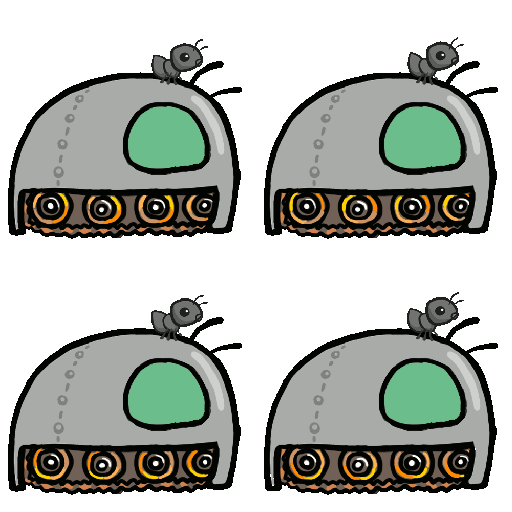 TankAnt |
6 | 2 |
We have not provided you with a class header.
Implement the TankAnt class from scratch. Give it a class attribute name
with the value 'Tank' (so that the graphics work) and a class attribute
implemented with the value True (so that you can use it in a game).
You should not need to modify any code outside of the TankAnt class. If you
find yourself needing to make changes elsewhere, look for a way to write your
code for the previous question such that it applies not just to BodyguardAnt
and TankAnt objects, but to container ants in general.
Hint: The only methods you need to override from
TankAnt's parent class are__init__andaction.
After writing code, test your implementation:
python3 ok -q 09Phase 4: Water and Might
Important submission note: For full credit,
- Submit with all phases complete by Tuesday, March 16.
You will get an extra credit point for submitting the entire project by Monday, March 15
In the final phase, you're going to add one last kick to the game by introducing a new type of place and new ants that are able to occupy this place. One of these ants is the most important ant of them all: the queen of the colony (although the game is completely playable without the queen ant, as it is extra credit).
Phase 4 Hint Videos
Problem 10 (2 pt)
Before writing any code, read the instructions and test your understanding of the problem:
python3 ok -q 10 -uLet's add water to the colony! Currently there are only two types of places, the
Hive and a basic Place. To make things more interesting, we're going to
create a new type of Place called Water.
Only an insect that is watersafe can be placed in Water. In order
to determine whether an Insect is watersafe, add a new class attribute to the
Insect class named is_watersafe that is set to False. Since bees can fly,
set their is_watersafe attribute to True, overriding the inherited value.
Now, implement the add_insect method for Water. First, add the insect to
the place regardless of whether it is watersafe. Then, if the insect is not
watersafe, reduce the insect's health to 0. Do not repeat code from elsewhere
in the program. Instead, use methods that have already been defined; this will be checked for composition scores!
After writing code, test your implementation:
python3 ok -q 10Once you've finished this problem, play a game that includes water. To access
the wet_layout, which includes water, add the --water option (or -w for
short) when you start the game.
python3 gui.py --water👩🏽💻👨🏿💻 Pair programming? Remember to alternate between driver and navigator roles! The driver controls the keyboard; the navigator watches, asks questions, and suggests ideas.
Problem 11 (2 pt)
Before writing any code, read the instructions and test your understanding of the problem:
python3 ok -q 11 -uCurrently there are no ants that can be placed on Water. Implement the
ScubaThrower, which is a subclass of ThrowerAnt that is more costly and
watersafe, but otherwise identical to its base class. A ScubaThrower should
not lose its health when placed in Water.
| Class | Food Cost | Initial Health |
 ScubaThrower |
6 | 1 |
We have not provided you with a class header. Implement the ScubaThrower
class from scratch. Give it a class attribute name with the value 'Scuba'
(so that the graphics work) and remember to set the class attribute
implemented with the value True (so that you can use it in a game).
After writing code, test your implementation:
python3 ok -q 11Extra Credit (2 pt)
Before writing any code, read the instructions and test your understanding of the problem:
python3 ok -q EC -uFinally, implement the QueenAnt. The queen is a waterproof ScubaThrower
that inspires her fellow ants through her bravery. In addition to the standard ScubaThrower action,
the QueenAnt doubles the
damage of all the ants behind her each time she performs an action. Once an
ant's damage has been doubled, it is not doubled again for subsequent turns.
The reflected damage of a fire ant should not be doubled, only the extra damage it deals when its health is reduced to 0
| Class | Food Cost | Initial Health |
 QueenAnt |
7 | 1 |
However, with great power comes great responsibility. The QueenAnt is
governed by three special rules:
- If the queen ever has its health reduced to 0, the bees win. The bees also
still win if any bee reaches the end of a tunnel. You can call
bees_win()to signal to the simulator that the game is over. - There can be only one true queen. Any queen instantiated beyond the first one is an impostor, and should have its health reduced to 0 upon taking its first action, without doubling any ant's damage or throwing anything. If an impostor dies, the game should still continue as normal.
- The true (first) queen cannot be removed. Attempts to remove the queen
should have no effect (but should not cause an error). You will need to
override
Ant.remove_frominQueenAntto enforce this condition.
Hint: All instances of the same class share the same class attributes. How can you use this information to tell whether a QueenAnt instance is the true QueenAnt?
Hint: You can find each
Placein a tunnel behind theQueenAntby starting at the ant'splace.exitand then repeatedly following itsexit. Theexitof aPlaceat the end of a tunnel isNone.Hint: To avoid doubling an ant's damage twice, mark the ants that have been buffed in some way, in a way that persists across calls to
QueenAnt action.Hint: When buffing the ants' damage, keep in mind that there can be more than one ant in one place!
After writing code, test your implementation:
python3 ok -q ECOptional Problems
During Office Hours and Project Parties, the staff will prioritize helping students with required questions. We will not be offering help with these questions unless the queue is empty.
Optional Problem 1
Before writing any code, read the instructions and test your understanding of the problem:
python3 ok -q optional1 -uImplement the NinjaAnt, which damages all Bees that pass by, but can never
be stung.
| Class | Food Cost | Initial Health |
 NinjaAnt |
5 | 1 |
A NinjaAnt does not block the path of a Bee that flies by. To implement
this behavior, first modify the Ant class to include a new class attribute
blocks_path that is set to True, then override the value of blocks_path to
False in the NinjaAnt class.
Second, modify the Bee's method blocked to return False if either
there is no Ant in the Bee's place or if there is an Ant, but
its blocks_path attribute is False. Now Bees will just fly past
NinjaAnts.
Finally, we want to make the NinjaAnt damage all Bees that fly past.
Implement the action method in NinjaAnt to reduce the health of all Bees
in the same place as the NinjaAnt by its damage attribute. Similar to
the FireAnt, you must iterate over a list of bees that may change.
Hint: Having trouble visualizing the test cases? Try drawing them out on paper! See the example in Game Layout for help.
After writing code, test your implementation:
python3 ok -q optional1For a challenge, try to win a game using only HarvesterAnt
and NinjaAnt.
Optional Problem 2
Before writing any code, read the instructions and test your understanding of the problem:
python3 ok -q optional2 -uImplement two final thrower ants that do zero damage, but instead apoly a
temporary "status" on the action method of a Bee instance that they
throw_at. This status is an action
(a function taking a GameState parameter) that temporarily
replaces the current action.
This replacement action lasts for a certain number
of calls upon it, after which subsequent calls simply invoke
the previous action (the
action that was present when the status was applied.)
We will be implementing two new ants that subclass ThrowerAnt.
SlowThrowerthrows sticky syrup at a bee, applying a slow status for 3 calls.ScaryThrowerintimidates a nearby bee, causing it to back away instead of advancing. (If the bee is already right next to the Hive and cannot go back further, it should not move. To check if a bee is next to the Hive, you might find theis_hiveinstance method ofPlaceuseful). The scare status lasts for 2 turns. Once a bee has been scared once, it can't be scared again.
| Class | Food Cost | Initial Health |
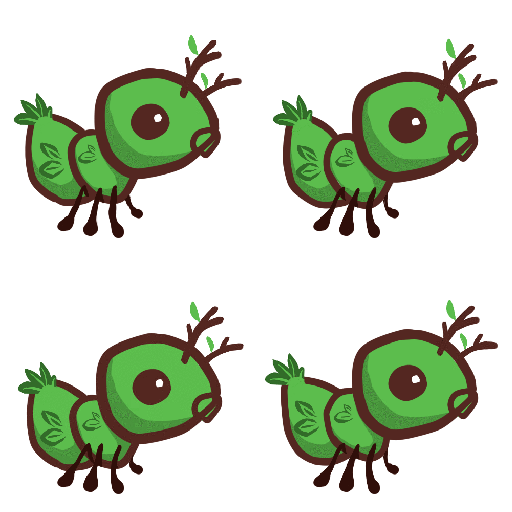 SlowThrower |
4 | 1 |
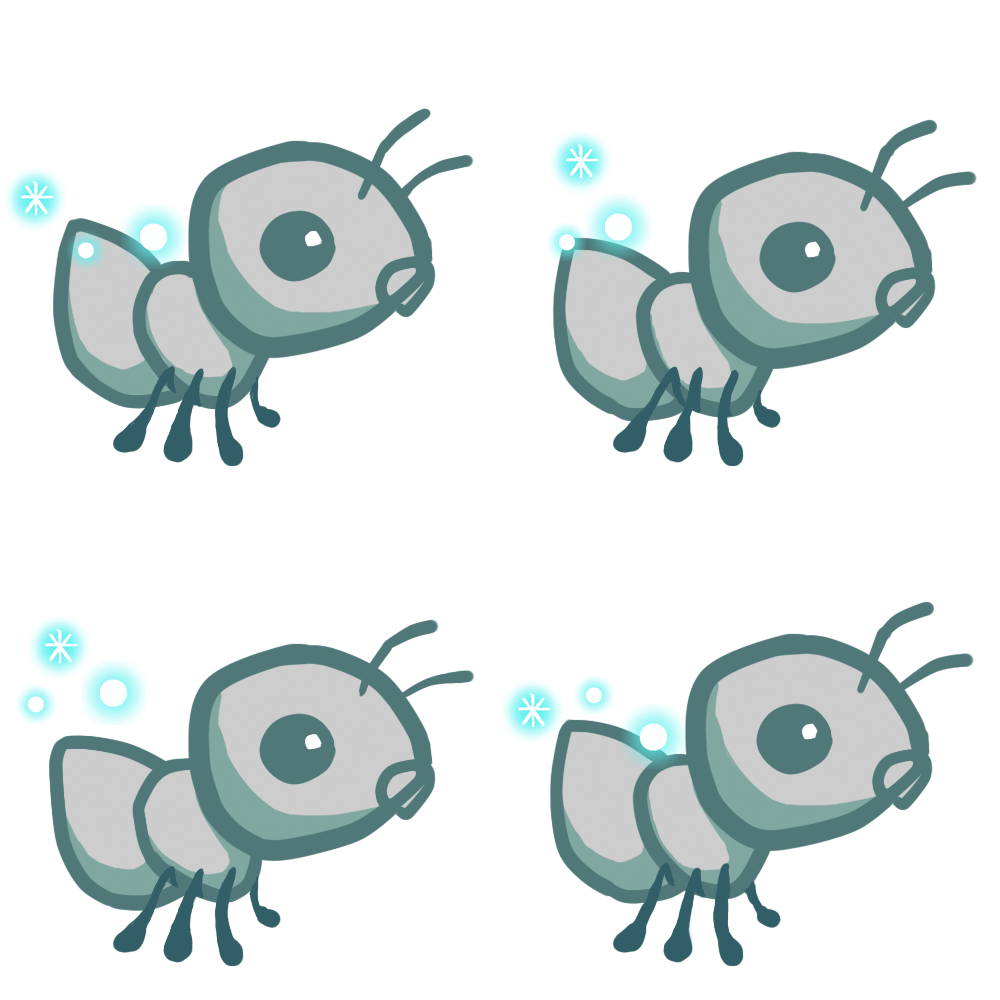 ScaryThrower |
6 | 1 |
In order to complete the implementations of these two ants, you will
need to set their class attributes appropriately and implement the
following three methods on Bees:
slowapplies a status that calls the previousaction(the one in effect when the status is applied) on every turn thatgamestate.timeis even and does nothing on other turns.scareapplies a status that makes the bee go backwards. It does nothing on aBeethat has previously been scared.apply_statusis an internal method onBees that is used byslowandscareto takes a status (as described above) and alengthand replace the current.actionmethod (which may itself be a previously applied status) with the new status forlengthcalls upon it.
Hint: to make a bee go backwards, consider adding an instance attribute indicating its current direction. Where should you change the bee's direction? Once the direction is known, how can you modify the
actionmethod ofBeeto move appropriately?Hint: You will need to assign a function to a method in one of the functions. The function you assign does not include a
selfparameter.class X: def f(self, x): return x def f(x): return x ** 3 x = X() x.f = f print(x.f(2)) # prints 8Take the example of a bee that has been slowed twice (say by two separate
SlowThrowers). It will have the following behavior:
- On time 1, the bee will do nothing. The second slow now has 2 turns to go; the first one still has 3 turns (since it will not have been called).
- On time 2, the bee moves forward. The second slow has 1 turn to go; the first one has 2 turns.
- On time 3, the bee will do nothing. The second slow has no turns left; the first one has 2 turns.
- On time 4, the bee moves forward. The first slow has 1 turn left.
- On time 5, the bee does nothing. The first slow has no turns left.
You can run some provided tests, but they are not exhaustive:
python3 ok -q optional2Make sure to test your code! Your code should be able to apply multiple statuses on a target; each new status applies to the current (possibly affected) action method of the bee.
Optional Problem 3
We've been developing this ant for a long time in secret. It's so dangerous
that we had to lock it in the super hidden CS61A underground vault, but we
finally think it is ready to go out on the field. In this problem, you'll be
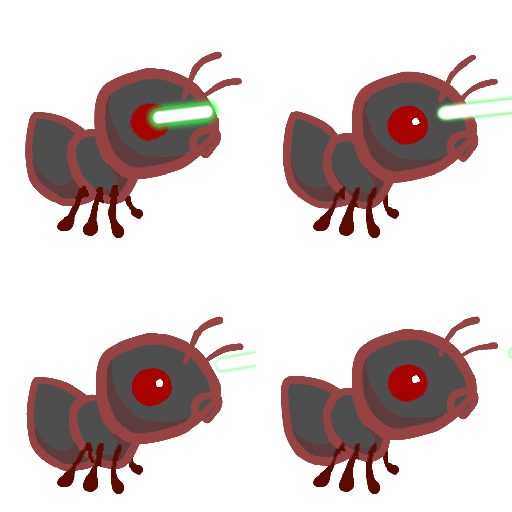
implementing the final ant -- LaserAnt, a ThrowerAnt with a twist.
| Class | Food Cost | Initial Health |
 LaserAnt |
10 | 1 |
The LaserAnt shoots out a powerful laser, damaging all that dare
to stand in its path. Both Bees and Ants, of all types, are at
risk of being damaged by LaserAnt. When a LaserAnt takes its action,
it will damage all Insects in its place (excluding itself, but including its
container if it has one) and the Places in front of it, excluding the Hive.
But, if that were it, LaserAnt would be too powerful for us to contain.
The LaserAnt has a base damage of 2. But, LaserAnt's laser comes with
some quirks. It is weakened by 0.25 each place it travels away from
LaserAnt's place. Additionally, LaserAnt's laser has limited battery.
Each time LaserAnt actually damages an Insect its
laser's total damage goes down by 0.0625 (1/16). If LaserAnt's damage becomes negative
due to these restrictions, it simply does 0 damage instead.
The exact order in which things are damaged within a turn is unspecified.
In order to complete the implementation of this ultimate ant, read
through the LaserAnt class, set the class attributes appropriately,
and implement the following two functions:
insects_in_frontis an instance method, called by theactionmethod, that takes inbeehive(the currentHive), and returns a dictionary where each key is anInsectand each corresponding value is the distance (in places) that thatInsectis away fromLaserAnt. The dictionary should include allInsectson the same place or in front of theLaserAnt, excludingLaserAntitself.calculate_damageis an instance method that takes indistance, the distance that an insect is away from theLaserAntinstance. It returns the damage that theLaserAntinstance should afflict based on:- The
distanceaway from theLaserAntinstance that anInsectis. - The number of
Insectsthat thisLaserAnthas damaged, stored in theinsects_shotinstance attribute.
- The
In addition to implementing the methods above, you may need to modify, add, or use
class or instance attributes in the LaserAnt class as needed.
You can run the provided sanity test, but it is not exhaustive:
python3 ok -q optional3Make sure to test your code!
Submission
Again, you will be turning in the following files:
ants.py
Please run the following command to submit the project:
python3 ok --submitYou can check to ensure that you have completed all the problems by running
python3 ok --scoreThen, go to your OK dashboard and verify that your submission was successful. You should see something like this:

You can click on the name of the assignment for more information about your submission. If you're experiencing issues with the autograder, remember that you can submit manually online.
Conclusion
You are now done with the project! If you haven't yet, you should try playing the game!
python3 gui.py [-h] [-d DIFFICULTY] [-w] [--food FOOD]Acknowledgments: Tom Magrino and Eric Tzeng developed this project with John DeNero. Jessica Wan contributed the original artwork. Joy Jeng and Mark Miyashita invented the queen ant. Many others have contributed to the project as well!
The new concept artwork was drawn by Alana Tran, Andrew Huang, Emilee Chen, Jessie Salas, Jingyi Li, Katherine Xu, Meena Vempaty, Michelle Chang, and Ryan Davis.