Homework 3 Solutions
Solution Files
You can find solutions for all questions in hw03.py.
Required questions
Q1: Num eights
Write a recursive function num_eights that takes a positive integer x and
returns the number of times the digit 8 appears in x.
Use recursion - the tests will fail if you use any assignment statements.
def num_eights(x):
    """Returns the number of times 8 appears as a digit of x.

    >>> num_eights(3)
    0
    >>> num_eights(8)
    1
    >>> num_eights(88888888)
    8
    >>> num_eights(2638)
    1
    >>> num_eights(86380)
    2
    >>> num_eights(12345)
    0
    >>> from construct_check import check
    >>> # ban all assignment statements
    >>> check(HW_SOURCE_FILE, 'num_eights',
    ...       ['Assign', 'AugAssign'])
    True
    """
    if x % 10 == 8:
        return 1 + num_eights(x // 10)
    elif x < 10:
        return 0
    else:
        return num_eights(x // 10)
Watch the hints video below for somewhere to start:
Use Ok to test your code:
python3 ok -q num_eightsThe equivalent iterative version of this problem might look something like this:
total = 0
while x > 0:
    if x % 10 == 8:
        total = total + 1
    x = x // 10
return total
The main idea is that we check each digit for a eight. The recursive solution is similar, except that you depend on the recursive call to count the occurences of eight in the rest of the number. Then, you add that to the number of eights you see in the current digit.
Q2: Ping-pong
The ping-pong sequence counts up starting from 1 and is always either counting
up or counting down. At element k, the direction switches if k is a
multiple of 8 or contains the digit 8. The first 30 elements of the ping-pong
sequence are listed below, with direction swaps marked using brackets at the
8th, 16th, 18th, 24th, and 28th elements:
| Index | 1 | 2 | 3 | 4 | 5 | 6 | 7 | [8] | 9 | 10 | 11 | 12 | 13 | 14 | 15 | [16] | 17 | [18] | 19 | 20 | 21 | 22 | 23 |
|---|---|---|---|---|---|---|---|---|---|---|---|---|---|---|---|---|---|---|---|---|---|---|---|
| PingPong Value | 1 | 2 | 3 | 4 | 5 | 6 | 7 | [8] | 7 | 6 | 5 | 4 | 3 | 2 | 1 | [0] | 1 | [2] | 1 | 0 | -1 | -2 | -3 |
| Index (cont.) | [24] | 25 | 26 | 27 | [28] | 29 | 30 |
|---|---|---|---|---|---|---|---|
| PingPong Value | [-4] | -3 | -2 | -1 | [0] | -1 | -2 |
Implement a function pingpong that returns the nth element of the ping-pong
sequence without using any assignment statements.
You may use the function num_eights, which you defined in the previous question.
Use recursion - the tests will fail if you use any assignment statements.
Hint: If you're stuck, first try implementing
pingpongusing assignment statements and awhilestatement. Then, to convert this into a recursive solution, write a helper function that has a parameter for each variable that changes values in the body of the while loop.
def pingpong(n):
    """Return the nth element of the ping-pong sequence.

    >>> pingpong(8)
    8
    >>> pingpong(10)
    6
    >>> pingpong(15)
    1
    >>> pingpong(21)
    -1
    >>> pingpong(22)
    -2
    >>> pingpong(30)
    -2
    >>> pingpong(68)
    0
    >>> pingpong(69)
    -1
    >>> pingpong(80)
    0
    >>> pingpong(81)
    1
    >>> pingpong(82)
    0
    >>> pingpong(100)
    -6
    >>> from construct_check import check
    >>> # ban assignment statements
    >>> check(HW_SOURCE_FILE, 'pingpong', ['Assign', 'AugAssign'])
    True
    """
    def helper(result, i, step):
        if i == n:
            return result
        elif i % 8 == 0 or num_eights(i) > 0:
            return helper(result - step, i + 1, -step)
        else:
            return helper(result + step, i + 1, step)
    return helper(1, 1, 1)

# Alternate solution 1
def pingpong_next(x, i, step):
    if i == n:
        return x
    return pingpong_next(x + step, i + 1, next_dir(step, i+1))

def next_dir(step, i):
    if i % 8 == 0 or num_eights(i) > 0:
        return -step
    return step

# Alternate solution 2
def pingpong_alt(n):
    if n <= 8:
        return n
    return direction(n) + pingpong_alt(n-1)

def direction(n):
    if n < 8:
        return 1
    if (n-1) % 8 == 0 or num_eights(n-1) > 0:
        return -1 * direction(n-1)
    return direction(n-1)
Watch the hints video below for somewhere to start:
Use Ok to test your code:
python3 ok -q pingpongThis is a fairly involved recursion problem, which we will first solve through iteration and then convert to a recursive solution.
Note that at any given point in the sequence, we need to keep track of the current value of the sequence (this is the value that might be output) as well as the current index of the sequence (how many items we have seen so far, not actually output).
For example, 14th element has value 0, but it's the 14th index in
the sequence. We will refer to the value as x and the index as i. An
iterative solution may look something like this:
def pingpong(n):
    i = 1
    x = 1
    while i < n:
        x += 1
        i += 1
    return x
Hopefully, it is clear to you that this has a big problem. This doesn't
account for changes in directions at all! It will work for the first eight
values of the sequence, but then fail after that. To fix this, we can add
in a check for direction, and then also keep track of the current
direction to make our lives a bit easier (it's possible to compute the
direction from scratch at each step, see the direction function in the
alternate solution).
def pingpong(n):
    i = 1
    x = 1
    is_up = True
    while i < n:
        is_up = next_dir(...)
        if is_up:
            x += 1
        else:
            x -= 1
        i += 1
    return x
All that's left to do is to write the next_dir function, which will take
in the current direction and index and then tell us what direction to
go in next (which could be the same direction):
def next_dir(is_up, i):
    if i % 8 == 0 or num_eights(i) > 0:
        return not is_up
    return is_up
There's a tiny optimization we can make here. Instead of calculating an
increment based on the value of is_up, we can make it directly store the
direction of change into the variable (next_dir is also updated, see the
solution for the new version):
def pingpong(n):
    i = 1
    x = 1
    step = 1
    while i < n:
        step = next_dir(step, i)
        x += step
        i += 1
    return x
This will work, but it uses assignment. To convert it to an equivalent recursive version without assignment, make each local variable into a parameter of a new helper function, and then add an appropriate base case. Lastly, we seed the helper function with appropriate starting values by calling it with the values we had in the iterative version.
You should be able to convince yourself that the version of pingpong in
the solutions has the same logic as the iterative version of pingpong
above.
Video walkthrough: https://youtu.be/74gwPjgrN_k
Q3: Missing Digits
Write the recursive function missing_digits that takes a number n that is sorted in increasing order (for example, 12289 is valid but 15362 and 98764 are not). It returns the number of missing digits in n. A missing digit is a number between the first and last digit of n of a that is not in n.
Use recursion - the tests will fail if you use while or for loops.
def missing_digits(n):
    """Given a number a that is in sorted, increasing order,
    return the number of missing digits in n. A missing digit is
    a number between the first and last digit of a that is not in n.
    >>> missing_digits(1248) # 3, 5, 6, 7
    4
    >>> missing_digits(19) # 2, 3, 4, 5, 6, 7, 8
    7
    >>> missing_digits(1122) # No missing numbers
    0
    >>> missing_digits(123456) # No missing numbers
    0
    >>> missing_digits(3558) # 4, 6, 7
    3
    >>> missing_digits(35578) # 4, 6
    2
    >>> missing_digits(12456) # 3
    1
    >>> missing_digits(16789) # 2, 3, 4, 5
    4

    >>> missing_digits(4) # No missing numbers between 4 and 4
    0
    >>> from construct_check import check
    >>> # ban while or for loops
    >>> check(HW_SOURCE_FILE, 'missing_digits', ['While', 'For'])
    True
    """
    if n < 10:
        return 0
    last, rest = n % 10, n // 10
    return max(last - rest % 10 - 1, 0) + missing_digits(rest)
# Alternate solution
def missing_digits_alt(n):
    def helper(n, digit):
        if n == 0:
            return 0
        last, rest = n % 10, n // 10
        if last == digit or last + 1 == digit:
            return helper(rest, last)
        return 1 + helper(n, digit - 1)
    return helper(n // 10, n % 10)
Watch the hints video below for somewhere to start:
Use Ok to test your code:
python3 ok -q missing_digitsmissing = 0 while n > 10: last, rest = n % 10, n // 10 missing += max(last - rest % 10 - 1, 0) n //= 10 return missing
A tricky case for this problem was handling adjacent numbers that are the same - that's why we wrap the digit difference each recursive call with a max comparison call to 0.
Q4: Count coins
Given a positive integer change, a set of coins makes change for change if
the sum of the values of the coins is change. Here we will use standard US Coin values: 1, 5, 10, 25 For example, the following
sets make change for 15:
- 15 1-cent coins
- 10 1-cent, 1 5-cent coins
- 5 1-cent, 2 5-cent coins
- 5 1-cent, 1 10-cent coins
- 3 5-cent coins
- 1 5-cent, 1 10-cent coin
Thus, there are 6 ways to make change for 15. Write a recursive function
count_coins that takes a positive integer change and returns the number of
ways to make change for change using coins. Use the get_next_coin function given to you to calculate the next largest coin denomination given your current coin. I.e. get_next_coin(5) = 10.
Hint: Refer the implementation of
count_partitionsfor an example of how to count the ways to sum up to a final value with smaller parts. If you need to keep track of more than one value across recursive calls, consider writing a helper function.
def get_next_coin(coin):
    """Return the next coin.
    >>> get_next_coin(1)
    5
    >>> get_next_coin(5)
    10
    >>> get_next_coin(10)
    25
    >>> get_next_coin(2) # Other values return None
    """
    if coin == 1:
        return 5
    elif coin == 5:
        return 10
    elif coin == 10:
        return 25

def count_coins(change):
    """Return the number of ways to make change using coins of value of 1, 5, 10, 25.
    >>> count_coins(15)
    6
    >>> count_coins(10)
    4
    >>> count_coins(20)
    9
    >>> count_coins(100) # How many ways to make change for a dollar?
    242
    >>> from construct_check import check
    >>> # ban iteration
    >>> check(HW_SOURCE_FILE, 'count_coins', ['While', 'For'])
    True
    """
    def constrained_count(change, smallest_coin):
        if change == 0:
            return 1
        if change < 0:
            return 0
        if smallest_coin == None:
            return 0
        without_coin = constrained_count(change, get_next_coin(smallest_coin))
        with_coin = constrained_count(change - smallest_coin, smallest_coin)
        return without_coin + with_coin
    return constrained_count(change, 1)
Watch the hints video below for somewhere to start:
Use Ok to test your code:
python3 ok -q count_coinsThis is remarkably similar to the count_partitions problem, with a
few minor differences:
- A maximum partition size is not given, so we need to create a helper function that takes in two arguments and also create another helper function to find the max coin.
- Partition size is not linear. To get the next
partition you need to call
get_next_coin
Submit
Make sure to submit this assignment by running:
python3 ok --submitJust for Fun Questions
Q5: Anonymous factorial
This question demonstrates that it's possible to write recursive functions without assigning them a name in the global frame.
The recursive factorial function can be written as a single expression by using a conditional expression.
>>> fact = lambda n: 1 if n == 1 else mul(n, fact(sub(n, 1)))
>>> fact(5)
120
However, this implementation relies on the fact (no pun intended) that
fact has a name, to which we refer in the body of fact. To write a
recursive function, we have always given it a name using a def or
assignment statement so that we can refer to the function within its
own body. In this question, your job is to define fact recursively
without giving it a name!
Write an expression that computes n factorial using only call
expressions, conditional expressions, and lambda expressions (no
assignment or def statements). Note in particular that you are not
allowed to use make_anonymous_factorial in your return expression.
The sub and mul functions from the operator module are the only
built-in functions required to solve this problem:
from operator import sub, mul

def make_anonymous_factorial():
    """Return the value of an expression that computes factorial.

    >>> make_anonymous_factorial()(5)
    120
    >>> from construct_check import check
    >>> # ban any assignments or recursion
    >>> check(HW_SOURCE_FILE, 'make_anonymous_factorial', ['Assign', 'AugAssign', 'FunctionDef', 'Recursion'])
    True
    """
    return (lambda f: lambda k: f(f, k))(lambda f, k: k if k == 1 else mul(k, f(f, sub(k, 1))))
    # Alternate solution:
    #   return (lambda f: f(f))(lambda f: lambda x: 1 if x == 0 else x * f(f)(x - 1))
Use Ok to test your code:
python3 ok -q make_anonymous_factorialQ6: Towers of Hanoi
This problem was covered in lecture, but feel free to use this question to test your understanding and re-implement the problem.
A classic puzzle called the Towers of Hanoi is a game that consists of three
rods, and a number of disks of different sizes which can slide onto any rod.
The puzzle starts with n disks in a neat stack in ascending order of size on
a start rod, the smallest at the top, forming a conical shape.

The objective of the puzzle is to move the entire stack to an end rod,
obeying the following rules:
- Only one disk may be moved at a time.
- Each move consists of taking the top (smallest) disk from one of the rods and sliding it onto another rod, on top of the other disks that may already be present on that rod.
- No disk may be placed on top of a smaller disk.
Complete the definition of move_stack, which prints out the steps required to
move n disks from the start rod to the end rod without violating the
rules. The provided print_move function will print out the step to move a
single disk from the given origin to the given destination.
Hint: Draw out a few games with various
non a piece of paper and try to find a pattern of disk movements that applies to anyn. In your solution, take the recursive leap of faith whenever you need to move any amount of disks less thannfrom one rod to another. If you need more help, see the following hints.
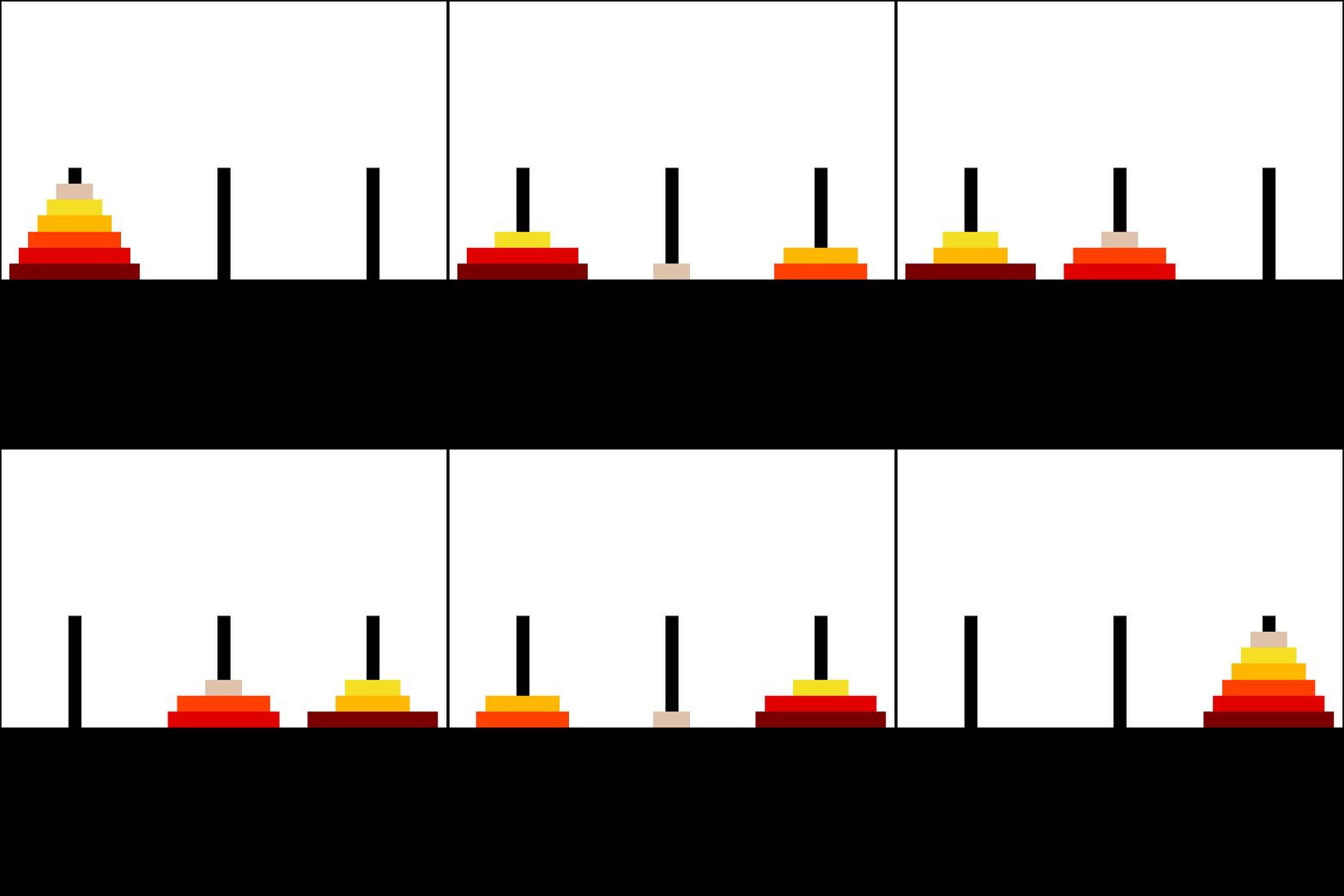

print effectively "collects" all the results in the terminal as long as you make sure that the moves are printed in order.
def print_move(origin, destination):
    """Print instructions to move a disk."""
    print("Move the top disk from rod", origin, "to rod", destination)

def move_stack(n, start, end):
    """Print the moves required to move n disks on the start pole to the end
    pole without violating the rules of Towers of Hanoi.

    n -- number of disks
    start -- a pole position, either 1, 2, or 3
    end -- a pole position, either 1, 2, or 3

    There are exactly three poles, and start and end must be different. Assume
    that the start pole has at least n disks of increasing size, and the end
    pole is either empty or has a top disk larger than the top n start disks.

    >>> move_stack(1, 1, 3)
    Move the top disk from rod 1 to rod 3
    >>> move_stack(2, 1, 3)
    Move the top disk from rod 1 to rod 2
    Move the top disk from rod 1 to rod 3
    Move the top disk from rod 2 to rod 3
    >>> move_stack(3, 1, 3)
    Move the top disk from rod 1 to rod 3
    Move the top disk from rod 1 to rod 2
    Move the top disk from rod 3 to rod 2
    Move the top disk from rod 1 to rod 3
    Move the top disk from rod 2 to rod 1
    Move the top disk from rod 2 to rod 3
    Move the top disk from rod 1 to rod 3
    """
    assert 1 <= start <= 3 and 1 <= end <= 3 and start != end, "Bad start/end"
    if n == 1:
        print_move(start, end)
    else:
        other = 6 - start - end
        move_stack(n-1, start, other)
        print_move(start, end)
        move_stack(n-1, other, end)
Watch the hints video below for somewhere to start:
Use Ok to test your code:
python3 ok -q move_stackTo solve the Towers of Hanoi problem for n disks, we need to do three
steps:
- Move everything but the last disk (
n-1disks) to someplace in the middle (not the start nor the end rod). - Move the last disk (a single disk) to the end rod. This must occur after step 1 (we have to move everything above it away first)!
- Move everything but the last disk (the disks from step 1) from the middle on top of the end rod.
We take advantage of the fact that the recursive function move_stack is
guaranteed to move n disks from start to end while obeying the rules
of Towers of Hanoi. The only thing that remains is to make sure that we
have set up the playing board to make that possible.
Since we move a disk to end rod, we run the risk of move_stack doing an
improper move (big disk on top of small disk). But since we're moving the
biggest disk possible, nothing in the n-1 disks above that is bigger.
Therefore, even though we do not explicitly state the Towers of Hanoi
constraints, we can still carry out the correct steps.
Video walkthrough: https://youtu.be/VwynGQiCTFM