Homework 6 Solutions
Solution Files
You can find the solutions in hw06.py.
Required Questions
Getting Started Videos
These videos may provide some helpful direction for tackling the coding problems on this assignment.
To see these videos, you should be logged into your berkeley.edu email.
OOP
Q1: Mint
A mint is a place where coins are made. In this question, you'll implement a Mint class that can output a Coin with the correct year and worth.
- Each
Mintinstance has ayearstamp. Theupdatemethod sets theyearstamp of the instance to thepresent_yearclass attribute of theMintclass. - The
createmethod takes a subclass ofCoin(not an instance!), then creates and returns an instance of that class stamped with themint's year (which may be different fromMint.present_yearif it has not been updated.) - A
Coin'sworthmethod returns thecentsvalue of the coin plus one extra cent for each year of age beyond 50. A coin's age can be determined by subtracting the coin's year from thepresent_yearclass attribute of theMintclass.
class Mint:
    """A mint creates coins by stamping on years.

    The update method sets the mint's stamp to Mint.present_year.

    >>> mint = Mint()
    >>> mint.year
    2022
    >>> dime = mint.create(Dime)
    >>> dime.year
    2022
    >>> Mint.present_year = 2102  # Time passes
    >>> nickel = mint.create(Nickel)
    >>> nickel.year     # The mint has not updated its stamp yet
    2022
    >>> nickel.worth()  # 5 cents + (80 - 50 years)
    35
    >>> mint.update()   # The mint's year is updated to 2102
    >>> Mint.present_year = 2177     # More time passes
    >>> mint.create(Dime).worth()    # 10 cents + (75 - 50 years)
    35
    >>> Mint().create(Dime).worth()  # A new mint has the current year
    10
    >>> dime.worth()     # 10 cents + (155 - 50 years)
    115
    >>> Dime.cents = 20  # Upgrade all dimes!
    >>> dime.worth()     # 20 cents + (155 - 50 years)
    125
    """
    present_year = 2022

    def __init__(self):
        self.update()

    def create(self, coin):
        return coin(self.year)
    def update(self):
        self.year = Mint.present_year
class Coin:
    cents = None # will be provided by subclasses, but not by Coin itself

    def __init__(self, year):
        self.year = year

    def worth(self):
        return self.cents + max(0, Mint.present_year - self.year - 50)
class Nickel(Coin):
    cents = 5

class Dime(Coin):
    cents = 10
Use Ok to test your code:
python3 ok -q MintLinked Lists
Q2: Store Digits
Write a function store_digits that takes in an integer n and returns
a linked list where each element of the list is a digit of n.
Important: Do not use any string manipulation functions like
strandreversed.
def store_digits(n):
    """Stores the digits of a positive number n in a linked list.

    >>> s = store_digits(1)
    >>> s
    Link(1)
    >>> store_digits(2345)
    Link(2, Link(3, Link(4, Link(5))))
    >>> store_digits(876)
    Link(8, Link(7, Link(6)))
    >>> # a check for restricted functions
    >>> import inspect, re
    >>> cleaned = re.sub(r"#.*\\n", '', re.sub(r'"{3}[\s\S]*?"{3}', '', inspect.getsource(store_digits)))
    >>> print("Do not use str or reversed!") if any([r in cleaned for r in ["str", "reversed"]]) else None
    >>> link1 = Link(3, Link(Link(4), Link(5, Link(6))))
    """
    result = Link.empty
    while n > 0:
        result = Link(n % 10, result)
        n //= 10
    return result
Use Ok to test your code:
python3 ok -q store_digitsQ3: Mutable Mapping
Implement deep_map_mut(func, link), which applies a function func onto
all elements in the given linked list lnk. If an element is itself a
linked list, apply func to each of its elements, and so on.
Your implementation should mutate the original linked list. Do not create any new linked lists.
Hint: The built-in
isinstancefunction may be useful.>>> s = Link(1, Link(2, Link(3, Link(4)))) >>> isinstance(s, Link) True >>> isinstance(s, int) False
Construct Check: The last doctest of this question ensures that you do not create new linked lists. If you are failing this doctest, ensure that you are not creating link lists by calling the constructor, i.e.
s = Link(1)
def deep_map_mut(func, lnk):
    """Mutates a deep link lnk by replacing each item found with the
    result of calling func on the item.  Does NOT create new Links (so
    no use of Link's constructor).

    Does not return the modified Link object.

    >>> link1 = Link(3, Link(Link(4), Link(5, Link(6))))
    >>> # Disallow the use of making new Links before calling deep_map_mut
    >>> Link.__init__, hold = lambda *args: print("Do not create any new Links."), Link.__init__
    >>> try:
    ...     deep_map_mut(lambda x: x * x, link1)
    ... finally:
    ...     Link.__init__ = hold
    >>> print(link1)
    <9 <16> 25 36>
    """
    if lnk is Link.empty:
        return
    elif isinstance(lnk.first, Link):
        deep_map_mut(func, lnk.first)
    else:
        lnk.first = func(lnk.first)
    deep_map_mut(func, lnk.rest)
Use Ok to test your code:
python3 ok -q deep_map_mutQ4: Two List
Implement a function two_list that takes in two lists and returns a linked list. The first list contains the
values that we want to put in the linked list, and the second list contains the number of each corresponding value.
Assume both lists are the same size and have a length of 1 or greater. Assume all elements in the second list
are greater than 0.
def two_list(vals, counts):
    """
    Returns a linked list according to the two lists that were passed in. Assume
    vals and counts are the same size. Elements in vals represent the value, and the
    corresponding element in counts represents the number of this value desired in the
    final linked list. Assume all elements in counts are greater than 0. Assume both
    lists have at least one element.

    >>> a = [1, 3, 2]
    >>> b = [1, 1, 1]
    >>> c = two_list(a, b)
    >>> c
    Link(1, Link(3, Link(2)))
    >>> a = [1, 3, 2]
    >>> b = [2, 2, 1]
    >>> c = two_list(a, b)
    >>> c
    Link(1, Link(1, Link(3, Link(3, Link(2)))))
    """
    def helper(count, index):
        if count == 0:
            if index + 1 == len(vals):
                return Link.empty
            return Link(vals[index + 1], helper(counts[index + 1] - 1, index + 1))
        return Link(vals[index], helper(count - 1, index))
    return helper(counts[0], 0)

#Iterative solution
def two_list_iterative(vals, counts):
    result = Link(None)
    p = result
    for index in range(len(vals)):
        item = vals[index]
        for _ in range(counts[index]):
            p.rest = Link(item)
            p = p.rest
    return result.rest
Use Ok to test your code:
python3 ok -q two_listSubmit
Make sure to submit this assignment by running:
python3 ok --submitOptional Questions
Q5: Next Virahanka Fibonacci Object
Implement the next method of the VirFib class. For this class, the value
attribute is a Fibonacci number. The next method returns a VirFib instance
whose value is the next Fibonacci number. The next method should take only
constant time.
Note that in the doctests, nothing is being printed out. Rather, each call to
.next() returns a VirFib instance. The way each VirFib instance is displayed is
determined by the return value of its __repr__ method.
Hint: Keep track of the previous number by setting a new instance attribute inside
next. You can create new instance attributes for objects at any point, even outside the__init__method.
class VirFib():
    """A Virahanka Fibonacci number.

    >>> start = VirFib()
    >>> start
    VirFib object, value 0
    >>> start.next()
    VirFib object, value 1
    >>> start.next().next()
    VirFib object, value 1
    >>> start.next().next().next()
    VirFib object, value 2
    >>> start.next().next().next().next()
    VirFib object, value 3
    >>> start.next().next().next().next().next()
    VirFib object, value 5
    >>> start.next().next().next().next().next().next()
    VirFib object, value 8
    >>> start.next().next().next().next().next().next() # Ensure start isn't changed
    VirFib object, value 8
    """

    def __init__(self, value=0):
        self.value = value

    def next(self):
        if self.value == 0:
            result = VirFib(1)
        else:
            result = VirFib(self.value + self.previous)
        result.previous = self.value
        return result
    def __repr__(self):
        return "VirFib object, value " + str(self.value)
Use Ok to test your code:
python3 ok -q VirFibRemember that next must return a VirFib object! With this in mind, our
first goal is to calculate the next VirFib object and return it. One
approach is to figure out the base case (self.value == 0) and then decide what
information is needed for the following call to next.
You might also note that storing the current value makes the solution look very
similar to the iterative version of the virfib problem.
Q6: Is BST
Write a function is_bst, which takes a Tree t and returns True if, and
only if, t is a valid binary search tree, which means that:
- Each node has at most two children (a leaf is automatically a valid binary search tree)
- The children are valid binary search trees
- For every node, the entries in that node's left child are less than or equal to the label of the node
- For every node, the entries in that node's right child are greater than the label of the node
An example of a BST is:
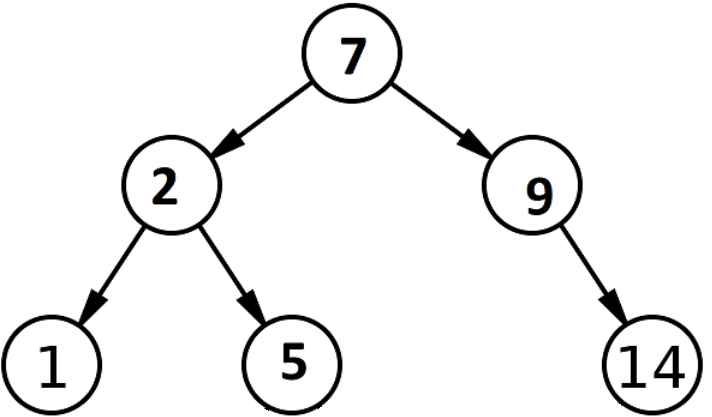
Note that, if a node has only one child, that child could be considered either the left or right child. You should take this into consideration.
Hint: It may be helpful to write helper functions bst_min and bst_max that
return the minimum and maximum, respectively, of a Tree if it is a valid binary
search tree.
def is_bst(t):
    """Returns True if the Tree t has the structure of a valid BST.

    >>> t1 = Tree(6, [Tree(2, [Tree(1), Tree(4)]), Tree(7, [Tree(7), Tree(8)])])
    >>> is_bst(t1)
    True
    >>> t2 = Tree(8, [Tree(2, [Tree(9), Tree(1)]), Tree(3, [Tree(6)]), Tree(5)])
    >>> is_bst(t2)
    False
    >>> t3 = Tree(6, [Tree(2, [Tree(4), Tree(1)]), Tree(7, [Tree(7), Tree(8)])])
    >>> is_bst(t3)
    False
    >>> t4 = Tree(1, [Tree(2, [Tree(3, [Tree(4)])])])
    >>> is_bst(t4)
    True
    >>> t5 = Tree(1, [Tree(0, [Tree(-1, [Tree(-2)])])])
    >>> is_bst(t5)
    True
    >>> t6 = Tree(1, [Tree(4, [Tree(2, [Tree(3)])])])
    >>> is_bst(t6)
    True
    >>> t7 = Tree(2, [Tree(1, [Tree(5)]), Tree(4)])
    >>> is_bst(t7)
    False
    """
    def bst_min(t):
        """Returns the min of t, if t has the structure of a valid BST."""
        if t.is_leaf():
            return t.label
        return min(t.label, bst_min(t.branches[0]))

    def bst_max(t):
        """Returns the max of t, if t has the structure of a valid BST."""
        if t.is_leaf():
            return t.label
        return max(t.label, bst_max(t.branches[-1]))

    if t.is_leaf():
        return True
    if len(t.branches) == 1:
        c = t.branches[0]
        return is_bst(c) and (bst_max(c) <= t.label or bst_min(c) > t.label)
    elif len(t.branches) == 2:
        c1, c2 = t.branches
        valid_branches = is_bst(c1) and is_bst(c2)
        return valid_branches and bst_max(c1) <= t.label and bst_min(c2) > t.label
    else:
        return False
Use Ok to test your code:
python3 ok -q is_bstExam Practice
Homework assignments will also contain prior exam questions for you to try. These questions have no submission component; feel free to attempt them if you'd like some practice!
Object-Oriented Programming
- Spring 2022 MT2 Q8: CS61A Presents The Game of Hoop.
- Fall 2020 MT2 Q3: Sparse Lists
- Fall 2019 MT2 Q7: Version 2.0
Linked Lists
- Fall 2020 Final Q3: College Party
- Fall 2018 MT2 Q6: Dr. Frankenlink
- Spring 2017 MT1 Q5: Insert